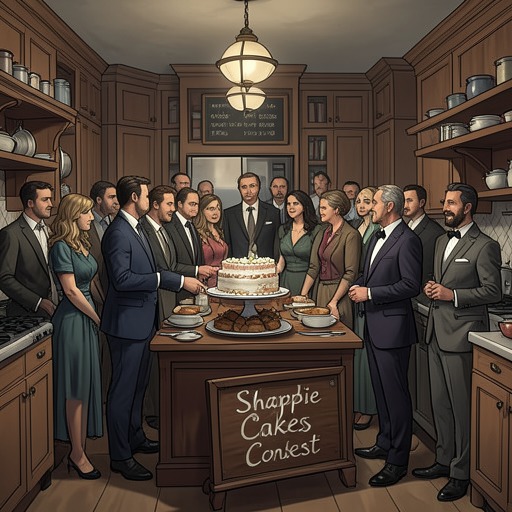
Sharpie Cakes
Blind Willow, Sleeping WomanSharpie Cakes are a traditional confection whose commercial decline prompts a competition for new products, but their defining test is not human taste: a flock of crows accepts or rejects each cake. In the contest, a homemade modern variation is judged alongside the company’s insistence on authenticity, turning an ordinary sweet into the object around which tradition, innovation, and a grotesquely literal standard of value collide.
Introduction and Appearance
The narrator first encounters Sharpie Cakes through a newspaper advertisement announcing that the Sharpie Cake Company is seeking new products and will hold an informational seminar. He has never heard of the cakes, but approaches them as someone exacting about confections and with time to spare. At the hotel ballroom, tea and Sharpies are served; he tries one and finds its texture sticky-sweet and its crust too dry. His first impression is not that the cakes are an obvious contemporary favorite, but that their appeal is difficult to understand.
The seminar’s scale suggests the product still commands substantial public attention. The narrator receives ticket number 952, and at least a hundred people arrive after him, bringing attendance to more than a thousand. The crowd is made up of people his age or younger, a detail that complicates his assumption that the confection’s old-fashioned taste could not appeal to younger consumers. The company’s need for new ideas exists alongside a conspicuously large audience for the product it hopes to renew.
Tradition and the Search for New Products
The company president begins with a purported history of Sharpies, tracing them to an eighth-century origin story and claiming that a poem about them appeared in the imperial anthology Kokinshu in 905. The narrator regards this account as dubious, but the room listens intently. The speech lasts an hour and repeatedly establishes the cakes as a confection with a long tradition; to the narrator, its length makes the simple point feel needlessly elaborate.
The managing director then explains why the company wants submissions. Sharpies, he says, are a distinguished national confection with a long history, but must develop in ways suited to each new age. The narrator reads the formal language as a more elaborate way of saying that the taste has grown old-fashioned and sales are falling. The company’s problem is therefore expressed as a tension: it sells the authority of tradition, yet asks young people to change the product so that it can continue to grow.
The narrator takes home the submission rules and decides to enter. Entrants must create a confection based on Sharpies and deliver it one month later; the prize is two million yen. He imagines using the money to marry his girlfriend and move into a new apartment. Since he can make bean jam, cream fillings, and pie crusts in different styles, he believes he can produce a contemporary version within the allotted month. On the due date, he brings two dozen new Sharpie Cakes to the company.
The Crows as Judges
The contest’s decisive standard is disclosed when the director takes the narrator through corridors and an elevator to a secured room on the sixth floor. A heavy iron door and a guard mark the unusual degree of security surrounding the company’s hidden adjudicators. The director introduces the Sharpie Crows as a special family of birds that has eaten nothing but Sharpie Cakes for centuries.
More than a hundred crows occupy the cavernous room, perched in packed rows on long poles beneath a fifteen-foot ceiling. They are far larger than ordinary crows, and the narrator observes that their eyes are replaced by white fatty growths and that their bodies are swollen. Their cries initially sound like an indistinct roar; as the narrator grows accustomed to the noise, he hears what seems to be the repeated word Sharpies. The scene makes the company’s claim about the birds concrete: these are not ordinary consumers but creatures physically and behaviorally defined by a single food.
The director explains the test plainly. The crows will eat genuine Sharpies and reject imitations; if they eat the narrator’s cakes, he wins, and if they do not, he loses. The company thus makes the birds’ response the final measure of a new product, despite the narrator’s immediate concern that a flock of birds should not decide a competition. The claimed distinction between the authentic and the imitative is not evaluated through a recipe, human tasting panel, or stated technical standard. It is delegated to the crows.
Contest and Consequences
When the director scatters the narrator’s new cakes onto the floor, the crows do not respond uniformly. Some eat them, while others spit them out. Birds unable to reach the cakes become agitated and attack birds that are eating; the disorder escalates into a general fight. The narrator objects that the director has thrown the cakes among them too suddenly, arguing that the stimulus was too strong. His protest does not undo the test or restore a clear distinction between acceptance and rejection.
The episode turns the contest’s premise into a darkly comic paradox. The crows are presented as unquestionable authorities on genuine Sharpies because they have eaten nothing else for centuries, yet their reactions to the new cakes divide the flock and produce chaos rather than a reliable verdict. The narrator’s recipe is judged not in a controlled tasting but in a setting where the company’s chosen standard can become a life-or-death matter for the birds. Sharpie Cakes consequently stand for both the product the company wants to preserve and the object it hopes to reinvent: the attempt to reconcile those aims ends with the judges themselves unable to respond as one.